CITMAga · Facultade de Matemáticas · Universidade de Santiago de Compostela

GLEN

Seminario Vidal Abascal

The differential geometry seminar of the Universidade de Santiago de Compostela. We usually meet every other week: Mondays at 10:00 in room 8 of the Facultade de Matemáticas.

Programme

· 10:00 · Room 8

Inhomogeneous Einstein metrics on complex projective spaces

Alberto Rodríguez Vázquez (Universidade de Santiago de Compostela)

Abstract

Complex projective space ℂPn, which parametrizes the complex lines in ℂn+1, is one of the most extensively studied objects in algebraic and complex geometry. The first Einstein metric discovered on ℂPn was the Fubini–Study metric, and in 1965 Berger asked whether it was the only one. In 1982, Ziller constructed a second homogeneous Einstein metric in odd complex dimensions. Berger's question remained open in even complex dimensions, where Fubini–Study was the only known Einstein metric.

Together with Gonzalo Cao Labora (EPFL, Switzerland), we have constructed new Einstein metrics on ℂPn for n ∈ {3, 4, 5, 6, 7}. These are the first known non-homogeneous examples and, together with the Fubini–Study and Ziller metrics, the only ones known to date. Our construction settles Berger's question in the previously open cases n = 4 and n = 6.

The construction relies on a cohomogeneity-one action by the Lie group SOn+1, which allows us to reduce the Einstein equations to a system of ODEs, reparametrized by the mean curvature of the principal orbits. One of the novel aspects of the work is the use of a computer-assisted proof, a methodology that has so far been relatively unexplored in differential geometry. We use interval arithmetic and Krawczyk's fixed-point theorem, a generalization of Newton's method that makes it possible to turn numerical analysis into a rigorous proof.
· 10:00 · Room 8

An inhomogeneous nearly parallel G2-structure on the Berger space and a sine cone desingularisation

Ragini Singhal

Abstract

Nearly G2 manifolds are positive Einstein seven-dimensional manifolds whose associated cone metric has special holonomy equal to, or contained in, Spin(7). We study nearly parallel G2-structures invariant under a cohomogeneity-one action of SO(4), and construct the first inhomogeneous nearly parallel G2-structure on the Berger space SO(5)/SO(3). The cone over this metric has full holonomy Spin(7). The existence of the solution is established by a rigorous computer-assisted shooting argument.

We also establish a local desingularisation of a finite quotient of the sine cone over S3 × S3 by gluing in the asymptotically conical C7 bubble constructed by Foscolo–Haskins–Nordström. We show that as the singular orbit of a family of nearly parallel G2 manifolds collapses, away from the singular orbit the desingularising family converges to the sine cone quotient, while the natural blow-up converges to the AC torsion-free G2-metric of C7. The talk is based on a joint work with Simon Salamon.

· 10:00 · Room 8

Jan Nienhaus

Title and abstract to be announced.

· 10:00 · Room 8

Speaker to be announced.

· 10:00 · Room 8

Speaker to be announced.

· 10:00 · Room 8

Speaker to be announced.

Enrique Vidal Abascal
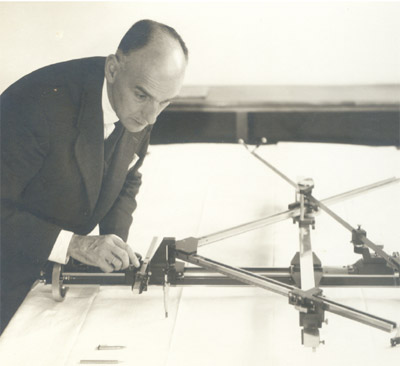
Enrique Vidal Abascal at work with one of his drawing instruments.

Enrique Vidal Abascal (1908–1994)

The seminar is named after Enrique Vidal Abascal, born in Oviedo in 1908 and died in Santiago de Compostela in 1994. Professor of Geometry at the Universidade de Santiago de Compostela from 1941, he is regarded as the founder of the Galician school of differential geometry, from which many of the geometers working in Galicia today descend.

His research focused on integral geometry and the theory of foliations, and he kept close ties with the French geometry of his time. He was also a founding member and the first president of the Real Academia Galega de Ciencias.